

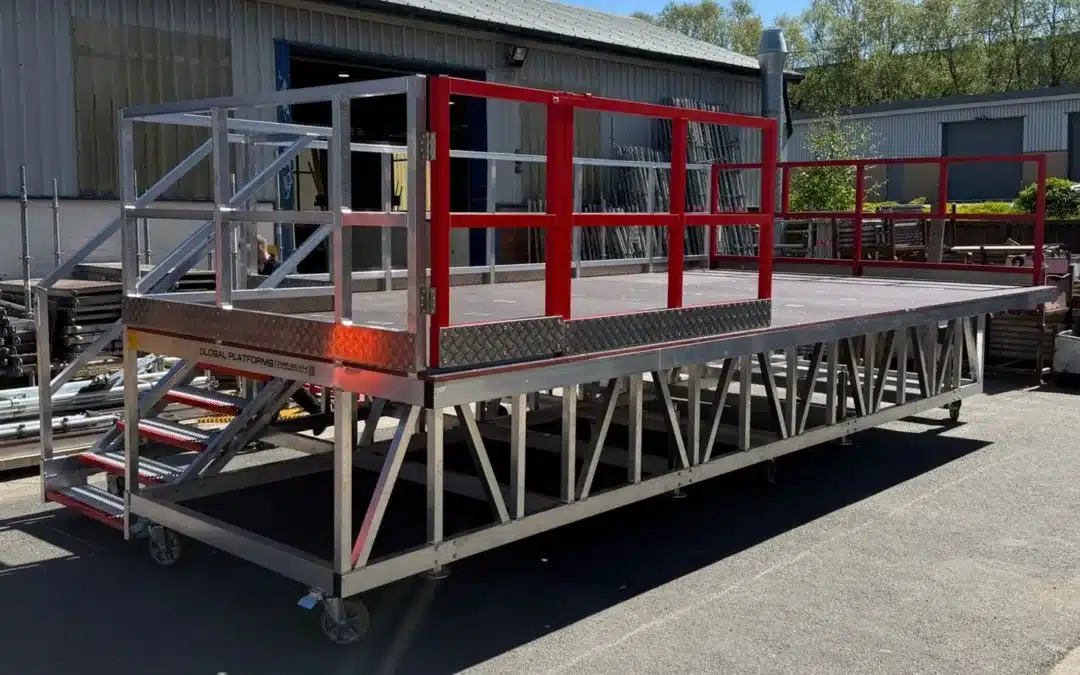
A working deck around an aircraft assembly jig has two jobs that pull against each other. It has to be continuous, so fitters can move safely around the build. It also has to leave the jig-alignment points reachable. This is how we resolved that for a tier-one tooling partner to a UK defence aerospace prime, starting from a placeholder sketch.

The Brief: Marry-Up Staging from a Sketch
The client needed marry-up staging, the working access around the point where aircraft structure is aligned and joined. The starting point was a placeholder sketch, so the design depended on what we found at survey and what we could prove before fabrication.
A Deck Level with the Tooling
We surveyed in December 2025. The deck sits level with the tooling at 1213mm and covers a 13m x 8.3m footprint, built from four mobile aluminium units. Mobile units mean the staging can be repositioned, rather than becoming a fixed obstruction in the hall.
Lift-Out Panels over Every Alignment Point
Over every jig-alignment pin and gap-setting block there is a lift-out infill panel with recessed lifting eyes. The deck stays continuous when the panels are in. When fitters need the alignment points underneath, the panel lifts out and the access is there.
Steps That Cannot Walk Away
Step-ups and hop-ups drop into steel-lined keyway slots and lock with a pin, so they never stand alone. That keeps them in position when someone steps on or off, which is where loose steps cause trouble.

Clash Checks and a Safety Review Before Fabrication
Before any metal was cut, we clash-checked a shared 3D model against the client’s assembly model. The end client’s safety team then reviewed the design. Their comments led us to redesign the step units to BS EN 131, which removed a trip hazard. That review is the reason to bring the safety team in early, not at handover.
Proof-Loaded and Delivered to Programme
- Proof-load tested, with a safe working load of 250kg
- Delivered between May and July 2026 to match the build plan
Planning Staging for Your Own Assembly Hall
If you are planning access around a jig, a fuselage section or a wing, tell us the programme and we will survey around it. We build in aluminium, coated mild steel or GRP, with anti-FOD (foreign object debris) detailing for aerospace environments.
Arrange an assembly hall survey
Tell us the jig, the programme and the access you need. We survey before we design, so the staging fits your build.
Contact Global PlatformsFrequently Asked Questions
What is marry-up staging?
It is the access staging around the point where aircraft structure sections are aligned and joined. It has to give fitters safe, continuous access while keeping the alignment points reachable.
Why use lift-out panels in a working deck?
They keep the deck continuous and safe to walk, while giving fitters access to the jig-alignment pins and gap-setting blocks underneath. Recessed lifting eyes make the panels easy to remove and refit.
How do you stop step units becoming a trip hazard?
On this job the step-ups and hop-ups drop into steel-lined keyway slots and lock with a pin, and the end client’s safety review led us to redesign them to BS EN 131.
What is a 3D clash check?
We compare a shared 3D model of the staging against the client’s assembly model, to find where the two physically conflict before anything is fabricated. It is far cheaper to move a panel on screen than on the shop floor.
Can you design staging from a rough sketch?
Yes. This project started from a placeholder sketch. We survey the site, build the design around what we find, and agree it with the client before fabrication.
What safe working load does aerospace staging need?
It depends on the tooling, the people and the equipment on the deck. This project was specified at 250kg safe working load and proof-load tested. We confirm the figure for your job at survey.
Which materials suit aerospace environments?
Aluminium is lightweight and suits frequent repositioning. GRP is non-conductive and suits areas near avionics, electrical and fuel zones. Coated mild steel suits heavy-duty or outdoor use. We apply anti-FOD detailing throughout.
Do you work with the end client’s safety team?
Yes, where the client wants it. On this project the end client’s safety team reviewed the design before fabrication, and their comments improved it.
Can you build aerospace platforms for sites outside the North West?
Yes. Our bespoke work covers the whole of the UK, and we can survey at your site.